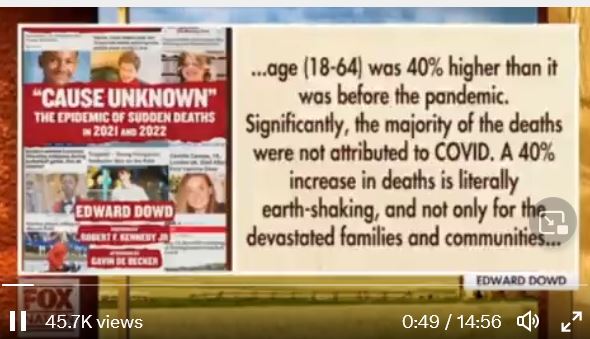
The CEO of the OneAmerica insurance company publicly disclosed that during the third and fourth quarters of 2021, death in people of working age (18-64) was 40% higher than it was before the pandemic. Significantly, the majority of the deaths were not attributed to COVID. Even a… pic.twitter.com/Hx5EbBjgKn
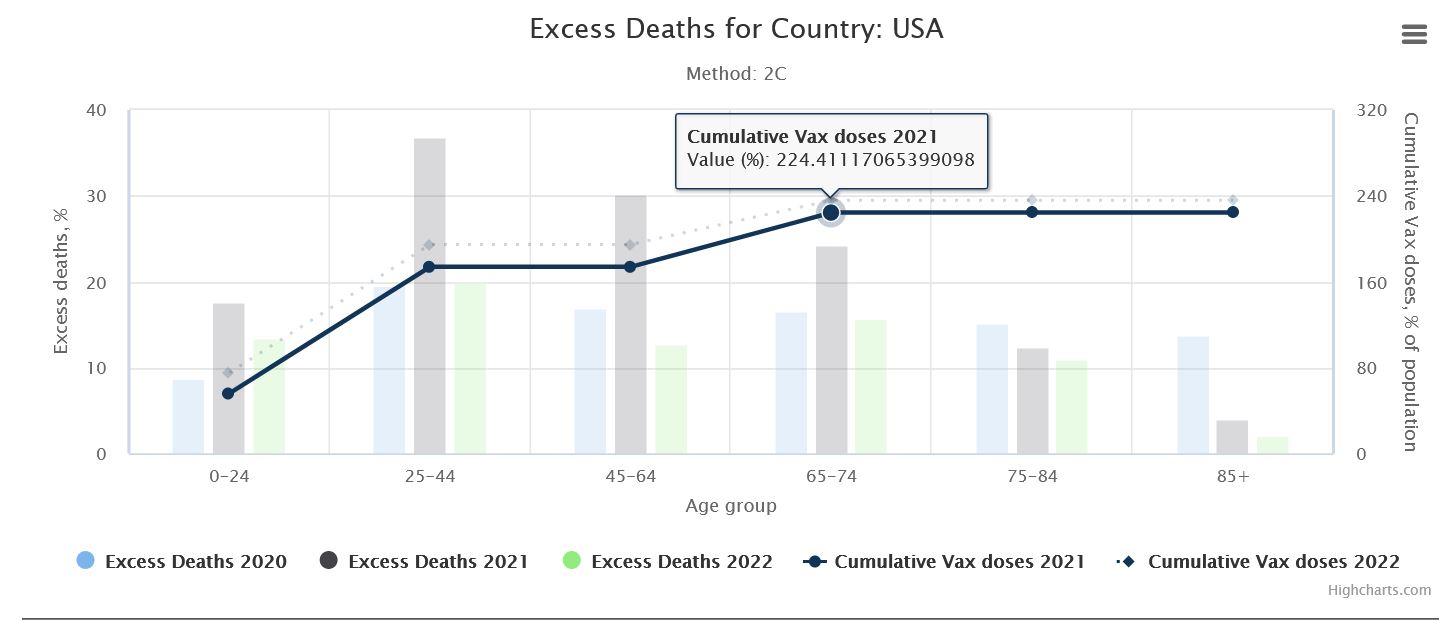
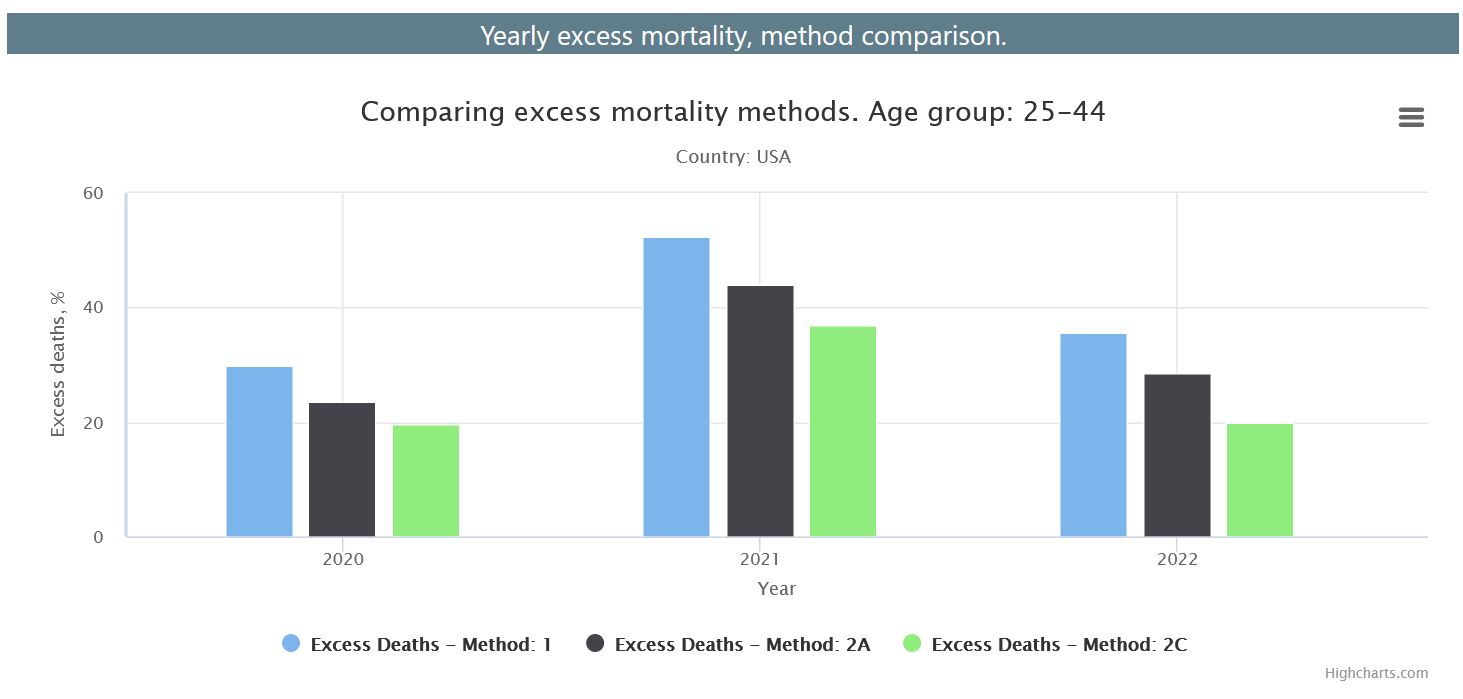
2020, 2021,2022 Ed Dowd did Under an organization called the Humanities Project compile a history of excess deaths during and after the pandemic and here is what they found.
Question Did more all-cause deaths occur during the first months of the coronavirus disease 2019 (COVID-19) pandemic in the United States compared with the same months during previous years?
Findings 2020 In this cohort study, the number of deaths due to any cause increased by approximately 122 000 from March 1 to May 30, 2020, which is 28% higher than the reported number of COVID-19 deaths.
Meaning Official tallies of deaths due to COVID-19 underestimate the full increase in deaths associated with the pandemic in many states.
Abstract
Importance Efforts to track the severity and public health impact of coronavirus disease 2019 (COVID-19) in the United States have been hampered by state-level differences in diagnostic test availability, differing strategies for prioritization of individuals for testing, and delays between testing and reporting. Evaluating unexplained increases in deaths due to all causes or attributed to nonspecific outcomes, such as pneumonia and influenza, can provide a more complete picture of the burden of COVID-19.
Objective To estimate the burden of all deaths related to COVID-19 in the United States from March to May 2020.
Design, Setting, and Population This observational study evaluated the numbers of US deaths from any cause and deaths from pneumonia, influenza, and/or COVID-19 from March 1 through May 30, 2020, using public data of the entire US population from the National Center for Health Statistics (NCHS). These numbers were compared with those from the same period of previous years. All data analyzed were accessed on June 12, 2020.
Main Outcomes and Measures Increases in weekly deaths due to any cause or deaths due to pneumonia/influenza/COVID-19 above a baseline, which was adjusted for time of year, influenza activity, and reporting delays. These estimates were compared with reported deaths attributed to COVID-19 and with testing data.
Results There were approximately 781 000 total deaths in the United States from March 1 to May 30, 2020, representing 122 300 (95% prediction interval, 116 800-127 000) more deaths than would typically be expected at that time of year. There were 95 235 reported deaths officially attributed to COVID-19 from March 1 to May 30, 2020. The number of excess all-cause deaths was 28% higher than the official tally of COVID-19–reported deaths during that period. In several states, these deaths occurred before increases in the availability of COVID-19 diagnostic tests and were not counted in official COVID-19 death records. There was substantial variability between states in the difference between official COVID-19 deaths and the estimated burden of excess deaths.
Conclusions and Relevance Excess deaths provide an estimate of the full COVID-19 burden and indicate that official tallies likely undercount deaths due to the virus. The mortality burden and the completeness of the tallies vary markedly between states.
Discussion
Monitoring excess deaths has been used as a method for tracking influenza mortality for more than a century. Herein, we used a similar strategy to capture COVID-19 deaths that had not been attributed specifically to the pandemic coronavirus. Monitoring trends in broad mortality outcomes, like changes in all-cause and pneumonia/influenza/COVID-19 mortality, provides a window into the magnitude of the mortality burden missed in official tallies of COVID-19 deaths. Given the variability in testing intensity between states and over time, this type of monitoring provides key information on the severity of the pandemic and the degree to which viral testing might be missing deaths caused by COVID-19. These findings demonstrate that estimates of the death toll of COVID-19 based on excess all-cause mortality may be more reliable than those relying only on reported deaths, particularly in places that lack widespread testing.
Syndromic end points, such as deaths due to pneumonia/influenza/COVID-19, outpatient visits for influenza-like illness, and emergency department visits for fever, can provide a crude but informative measure of the progression of the outbreak.18 These measures themselves can be biased by changes in health-seeking behavior and how conditions are recorded. However, in the absence of widespread and systematic testing for COVID-19, they provide a useful measure of pandemic progression and the impact of interventions.
The gap between reported COVID-19 deaths and excess deaths can be influenced by several factors, including the intensity of testing; guidelines on the recording of deaths that are suspected to be related to COVID-19 but do not have a laboratory confirmation; and the location of death (eg, hospital, nursing home, or unattended death at home). For instance, deaths that occur in nursing homes might be more likely to be recognized as part of an epidemic and correctly recorded as due to COVID-19. As the pandemic has progressed, official statistics have become better aligned with excess mortality estimates, perhaps due to enhanced testing and increased recognition of the clinical features of COVID-19. In New York City, official COVID-19 death counts were revised after careful inspection of death certificates, adding an extra 5048 probable deaths to the 13 831 laboratory-confirmed deaths.19 As a result, the all-cause excess mortality burden from March 11 to May 2, 2020, is only 27% higher than official COVID-19 statistics.19 This aligns well with our estimate of 26% for a similar period in New York City, using a slightly different modeling approach.
Many European countries have experienced sharp increases in all-cause deaths associated with the pandemic. Real-time all-cause mortality data from the EuroMomo project (https://www.euromomo.eu/) demonstrate gaps between the official COVID-19 death toll and excess deaths that echo findings in our study. These gaps are more pronounced in countries that were affected more and earlier by the pandemic and had weak testing. Very limited excess mortality information is available from Asia, Africa, the Middle East, and South America thus far; these data will be important to fully capture the heterogeneity of death rates related to the COVID-19 pandemic across the world. Prior work on the 1918 and 2009 pandemics has shown substantial heterogeneity in mortality burden between countries, in part related to health care.8,20
Humanities Project Excess Deaths USA by Year and Vaccination Status
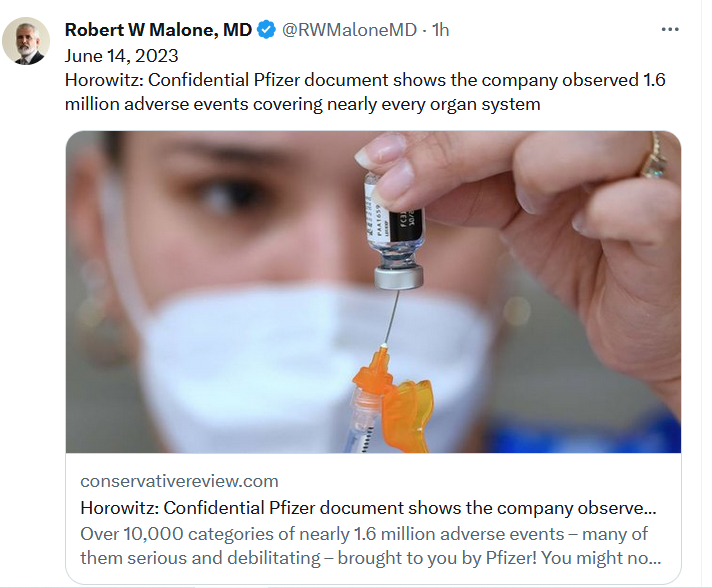
Horowitz Possible Explanation from Pfizer Databank
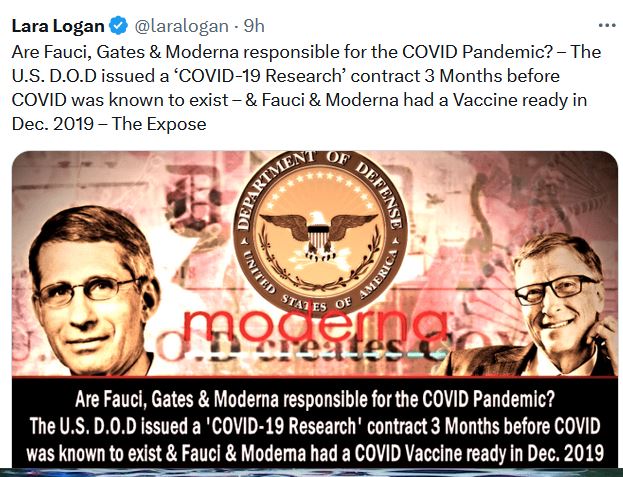
The Iowa senator introduced legislation to permanently defund EcoHealth Alliance. WASHINGTON – U.S. Senator Joni Ernst (R-Iowa) is calling on Congress to put an immediate and permanent end to taxpayer funding of EcoHealth Alliance following the release of an investigation today that found the organization mismanaged coronavirus experiments in Wuhan, China. Senator Ernst requested the investigation by the Department of Health and Human Services’ (HHS) Office of Inspector General (OIG) upon learning that EcoHealth was spending tax dollars on dangerous coronaviruses in Communist China’s Wuhan Institute of Virology (WIV) and was not disclosing information about those projects to the public, as required by law.The investigation found EcoHealth, WIV, and the National Institutes of Health (NIH) were all at fault for mismanagement: EcoHealth did not immediately notify NIH when a coronavirus was enhanced to become more lethal, as required; and, when it did, NIH did not quickly act to have the pathogen reviewed for pandemic potential. EcoHealth misspent tens of thousands of tax dollars on bonuses, junkets, and other unallowable costs. China’s WIV did not cooperate. The OIG suggests that WIV should be permanently barred from receiving U.S. taxpayer dollars, EcoHealth should return misspent taxpayer money, and NIH should increase oversight of EcoHealth and other projects involving pathogens with pandemic potential. Ernst’s response to the HHS investigation: “While NIH certainly shares in the blame, EcoHealth Alliance is ultimately at fault for failing to tell the world what was really going on at China’s Wuhan Institute. They are guilty of either complacency or a cover-up, or maybe a little of both,” said Ernst.“EcoHealth was paid millions, promising their hunt for bat viruses would protect the world from a pandemic…well, the world got a pandemic, and EcoHealth keeps getting millions. We can’t afford any more of EcoHealth’s ‘prevention’ efforts. That’s why we mustpermanently ban them from receiving taxpayer dollars ever again.” Since the world learned of the COVID-19 pandemic at the beginning of 2020 – including the role EcoHealth might have played in a potential lab leak— EcoHealth has been given more than $40 million in taxpayer dollars. Just last month, the Biden administration awarded the group $3 million out of the Department of Defense (DOD) budget. Ernst’s response to the administration’s latest check to EcoHealth: “The Biden administration is funding EcoHealth to search for risky viruses in places all across the globe, except where they might actually find them: in their own lab experiments! Washington is looking for ways to trim spending, so let’s start by cutting the millions of dollars flowing to EcoHealth’s batty experiments,” said Ernst.2. Yesterday Russia claimed Labs in Ukraine created the covid problem.
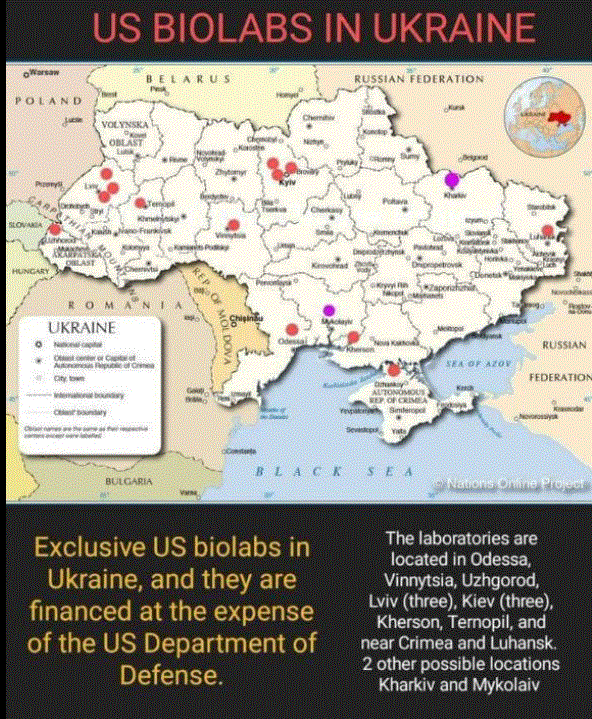
3. Zelensky Ordered Destruction of All State Docs Associated with METABIOTA on 02/24/22. WAS METABIOTA DOING ILLEGAL STUFF regarding covid in Ukraine and why would Selensky order Dept of Defense Records on METABIOTA destroyed??
Legal Ramifications of Conducting Secret Research on biowarfare capable pathogens stem from an International Convention on Pathogensx for the purpose of military use. The Biological Weapons Convention (BWC), or Biological and Toxin Weapons Convention (BTWC), is a disarmament treaty that effectively bans biological and toxin weapons by prohibiting their development, production, acquisition, transfer, stockpiling and use. The Convention Articles Biological Weapons Convention Preamble Convention on the Prohibition of the Development, Production and Stockpiling of Bacteriological (Biological) and Toxin Weapons and on their Destruction The States Parties to this Convention, Determined to act with a view to achieving effective progress towards general and complete disarmament, including the prohibition and elimination of all types of weapons of mass destruction, and convinced that the prohibition of the development, production and stockpiling of chemical and bacteriological (biological) weapons and their elimination, through effective measures, will facilitate the achievement of general and complete disarmament under strict and effective international control, Recognising the important significance of the Protocol for the Prohibition of the Use in War of Asphyxiating, Poisonous or Other Gases, and of Bacteriological Methods of Warfare, signed at Geneva on 17 June 1925, and conscious also of the contribution which the said Protocol has already made and continues to make, to mitigating the horrors of war, Reaffirming their adherence to the principles and objectives of that Protocol and calling upon all States to comply strictly with them, Recalling that the General Assembly of the United Nations has repeatedly condemned all actions contrary to the principles and objectives of the Geneva Protocol of 17 June 1925, Desiring to contribute to the strengthening of confidence between peoples and the general improvement of the international atmosphere, Desiring also to contribute to the realisation of the purposes and principles of the Charter of the United Nations, Convinced of the importance and urgency of eliminating from the arsenals of States, through effective measures, such dangerous weapons of mass destruction as those using chemical or bacteriological (biological) agents, Recognising that an agreement on the prohibition of bacteriological (biological) and toxin weapons represents a first possible step towards the achievement of agreement on effective measures also for the prohibition of the development, production and stockpiling of chemical weapons, and determined to continue negotiations to that end, Determined, for the sake of all mankind, to exclude completely the possibility of bacteriological (biological) agents and toxins being used as weapons, Convinced that such use would be repugnant to the conscience of mankind and that no effort should be spared to minimise this risk, Have agreed as follows: Article I Each State Party to this Convention undertakes never in any circumstances to develop, produce, stockpile or otherwise acquire or retain: (1) microbial or other biological agents, or toxins whatever their origin or method of production, of types and in quantities that have no justification for prophylactic, protective or other peaceful purposes; (2) weapons, equipment or means of delivery designed to use such agents or toxins for hostile purposes or in armed conflict. Article II Each State Party to this Convention undertakes to destroy, or to divert to peaceful purposes, as soon as possible but not later than nine months after the entry into force of the Convention, all agents, toxins, weapons, equipment and means of delivery specified in Article I of the Convention, which are in its possession or under its jurisdiction or control. In implementing the provisions of this Article all necessary safety precautions shall be observed to protect populations and the environment. Article III Each State Party to this Convention undertakes not to transfer to any recipient whatsoever, directly or indirectly, and not in any way to assist, encourage, or induce any State, group of States or international organisations to manufacture or otherwise acquire any of the agents, toxins, weapons, equipment or means of delivery specified in Article I of the Convention. Article IV Each State Party to this Convention shall, in accordance with its constitutional processes, take any necessary measures to prohibit and prevent the development, production, stockpiling, acquisition or retention of the agents, toxins, weapons, equipment and means of delivery specified in Article I of the Convention, within the territory of such State, under its jurisdiction or under its control anywhere. Article V The States Parties to this Convention undertake to consult one another and to co-operate in solving any problems which may arise in relation to the objective of, or in the application of the provisions of, the Convention. Consultation and co-operation pursuant to this Article may also be undertaken through appropriate international procedures within the framework of the United Nations and in accordance with its Charter. Article VI (1) Any State Party to this Convention which finds that any other State Party is acting in breach of obligations deriving from the provisions of the Convention may lodge a complaint with the Security Council of the United Nations. Such a complaint should include all possible evidence confirming its validity, as well as a request for its consideration by the Security Council. (2) Each State Party to this Convention undertakes to co-operate in carrying out any investigation which the Security Council may initiate, in accordance with the provisions of the Charter of the United Nations, on the basis of the complaint received by the Council. The Security Council shall inform the States Parties to the Convention of the results of the investigation. Article VII Each State Party to this Convention undertakes to provide or support assistance, in accordance with the United Nations Charter, to any Party to the Convention which so requests, if the Security Council decides that such Party has been exposed to danger as a result of violation of the Convention. Article VIII Nothing in this Convention shall be interpreted as in any way limiting or detracting from the obligations assumed by any State under the Protocol for the Prohibition of the Use in War of Asphyxiating, Poisonous or Other Gases, and of Bacteriological Methods of Warfare, signed at Geneva on 17 June 1925. Article IX Each State Party to this Convention affirms the recognised objective of effective prohibition of chemical weapons and, to this end, undertakes to continue negotiations in good faith with a view to reaching early agreement on effective measures for the prohibition of their development, production and stockpiling and for their destruction, and on appropriate measures concerning equipment and means of delivery specifically designed for the production or use of chemical agents for weapons purposes. Article X (1) The States Parties to this Convention undertake to facilitate, and have the right to participate in, the fullest possible exchange of equipment, materials and scientific and technological information for the use of bacteriological (biological) agents and toxins for peaceful purposes. Parties to the Convention in a position to do so shall also co-operate in contributing individually or together with other States or international organisations to the further development and application of scientific discoveries in the field of bacteriology (biology) for the prevention of disease, or for other peaceful purposes. (2) This Convention shall be implemented in a manner designed to avoid hampering the economic or technological development of States Parties to the Convention or international co-operation in the field of peaceful bacteriological (biological) activities, including the international exchange of bacteriological (biological) agents and toxins and equipment for the processing, use or production of bacteriological (biological) agents and toxins for peaceful purposes in accordance with the provisions of the Convention. Article XI Any State Party may propose amendments to this Convention. Amendments shall enter into force for each State Party accepting the amendments upon their acceptance by a majority of the States Parties to the Convention and thereafter for each remaining State Party on the date of acceptance by it. Article XII Five years after the entry into force of this Convention, or earlier if it is requested by a majority of Parties to the Convention by submitting a proposal to this effect to the Depositary Governments, a conference of States Parties to the Convention shall be held at Geneva, Switzerland, to review the operation of the Convention, with a view to assuring that the purposes of the preamble and the provisions of the Convention, including the provisions concerning negotiations on chemical weapons, are being realised. Such review shall take into account any new scientific and technological developments relevant to the Convention. Article XIII (1) This Convention shall be of unlimited duration. (2) Each State Party to this Convention shall in exercising its national sovereignty have the right to withdraw from the Convention if it decides that extraordinary events, related to the subject matter of the Convention, have jeopardised the supreme interests of its country. It shall give notice of such withdrawal to all other States Parties to the Convention and to the United Nations Security Council three months in advance. Such notice shall include a statement of the extraordinary events it regards as having jeopardised its supreme interests. Article XIV (1) This Convention shall be open to all States for signature. Any State which does not sign the Convention before its entry into force in accordance with paragraph 3 of this Article may accede to it at any time. (2) This Convention shall be subject to ratification by signatory States. Instruments of ratification and instruments of accession shall be deposited with the Governments of the United Kingdom of Great Britain and Northern Ireland, the Union of Soviet Socialist Republics and the United States of America, which are hereby designated the Depositary Governments. (3) This Convention shall enter into force after the deposit of instruments of ratification by twenty-two Governments, including the Governments designated as Depositaries of the Convention. (4) For States whose instruments of ratification or accession are deposited subsequent to the entry into force of this Convention, it shall enter into force on the date of the deposit of their instruments of ratification or accession. (5) The Depositary Governments shall promptly inform all signatory and acceding States of the date of each signature, the date of deposit of each instrument of ratification or of accession and the date of the entry into force of this Convention, and of the receipt of other notices. (6) This Convention shall be registered by the Depositary Governments pursuant to Article 102 of the Charter of the United Nations. Article XV This Convention, the English, Russian, French, Spanish and Chinese texts of which are equally authentic, shall be deposited in the archives of the Depositary Governments. Duly certified copies of the Convention shall be transmitted by the Depositary Governments to the Governments of the signatory and acceding States. Edits. This page was last edited on 15 February 2021, at 20:26.THE AFOREMENTIONED DOCUMENTS HAVE STRONG CLUES THAT THE AMERICAN ADMINISTRATION AND BIDENS IN PARTICULAR MAY HAVE VIOLATED THE INTERNATIONAL CONVENTION ON BIOLOGICAL WEAONS BY COVERT FUNDING OF PATHOGENS CAPABLE OF CAUSING A PANDEMIC AAND SHOULD BE REFERRED TO INTERPOL AND THE ICC AND UN SECRETARIAT ON BIOLOGICAL WEAPONS FOR CRIMINAL INVESTIGATION.





 Personal Page of Jorma Jyrkkanen, Composer, Author, Researcher