Berlusconi said Ukraine started the war by attacking Donbass, the Russian Speaking part of Ukraine. Stone mentioned this same thing.
Bush in 2008 at the Bucharest Conference
https://twitter.com/i/status/1696597338024714635

THE MINSK AGREEMENT
https://peacemaker.un.org/sites/peacemaker.un.org/files/UA_150212_MinskAgreement_en.pdf
Package of measures for the Implementation of the Minsk agreements
- Immediate and comprehensive ceasefire in certain areas of the Donetsk and Lugansk regions
of Ukraine and its strict implementation starting from 00.00 AM (Kiev time) on the 15th of
February, 2015. - Withdrawal of heavy weapons by both sides on equal distances in order to create a security
zone at least 50 km wide from each other for the artillery systems with caliber greater than
100mm and more, a security zone of 70 km wide for MLRS and 140 km wide for MLRS
“Tornado-C”, “Uragan”, “Smerch” and Tactical missile systems “Tochka” (“Tochka U”):
- for the Ukrainian troops: from the de facto line of contact;
- for the armed formations from certain areas of the Donetsk and Lugansk oblast of Ukraine
from the line of contact according to the Minsk memorandum of September 19, 2014.
The withdrawal of the heavy weapons as specified above is to start on day 2 of the ceasefire at
the latest and to be completed within 14 days.
The process shall be facilitated by the OSCE and supported by the Trilateral Contact Group.
- Ensure effective monitoring and verification of the ceasefire regime and the withdrawal of
heavy weapons by the OSCE from the day 1 of the withdrawal, using all technical equipment
necessary, including satellites, drones, radar equipment, etc. - Launch a dialogue, on day 1 of the withdrawal on modalities of local elections in accordance
with Ukrainian legislation and the Law of Ukraine “On interim local self-government order in
certain areas of the Donetsk and Lugansk regions” as well as on the future regime of these
areas based on this Law.
Adopt promptly, by no later than 30 days after the date of signing of the document a
resolution of the Parliament of Ukraine specifying the area enjoying the special regime, under
the Law of Ukraine On interim local self-government order in certain areas of the Donetsk and
Lugansk regions”, based on the line of the Minsk Memorandum of September 19, 2014. - Ensure pardon and amnesty by enacting the law prohibiting the prosecution and punishment
of persons in connection with the events that took place in certain areas of the Donetsk and
Lugansk regions of Ukraine. - Ensure release and exchange of all hostages and unlawfully detained persons, based on the
principle “all for all”. This process is to be finished on the day 5 after the withdrawal at the
latest. - Ensure safe access, delivery, storage, and distribution of humanitarian assistance to those in
need, on the basis of an international mechanism. - Definition of modalities of full resumption of socio-economic ties, including social transfers,
such as pension, payments and other payments (incomes and revenues, timely payments of all
utility bills, reinstating taxation within the legal framework of Ukraine).
To this end, Ukraine shall reinstate control of the segment of its banking system in the conflict-
affected areas and possibly an international mechanism to facilitate such transfers shall be
established. - Reinstatement of full control of the state border by the government of Ukraine throughout the
conflict area, starting on day 1 after the local elections and ending after the comprehensive
political settlement (local elections in certain areas of the Donetsk and Lugansk regions on the
basis of the Law of Ukraine and constitutional reform) to be finalized by the end of 2015,
provided that paragraph 11 has been implemented in consultation with and upon agreement
by representatives of certain areas of the Donetsk and Lugansk regions in the framework of
the Trilateral Contact Group. - Withdrawal of all foreign armed formations, military equipment, as well as mercenaries from
the territory of Ukraine under monitoring of the OSCE. Disarmament of all illegal groups. - Carrying out constitutional reform in Ukraine with a new Constitution entering into force by
the end of 2015, providing for decentralization as a key element (including a reference to the
specificities of certain areas in the Donetsk and Lugansk regions, agreed with the
representatives of these areas), as well as adopting permanent legislation on the special status
of certain areas of the Donetsk and Lugansk regions in line with measures as set out in the
footnote until the end of 2015i. - Based on the Law of Ukraine “On interim local self-government order in certain areas of the
Donetsk and Lugansk regions”, questions related to local elections will be discussed and
agreed upon with representatives of certain areas of the Donetsk and Lugansk regions in the
framework of the Trilateral Contact Group. Elections will be held in accordance with relevant
OSCE standards and monitored by OSCE/ODIHR. - Intensify the work of the Trilateral Contact Group including through the establishment of
working groups on the implementation of relevant aspects of the Minsk agreements. They will
reflect the composition of the Trilateral Contact Group.
Participants of the Trilateral Contact Group:
Ambassador Heidi Tagliavini
Second President of Ukraine, L.D. Kuchma
Ambassador of the Russian Federation to Ukraine, M.Y. Zurabov
A.V. Zakharchenko
I.V. Plotnitskiy
Minsk, 12 February 2015
i Such measures are, according to the Law on the special order for local self-government in certain areas of
the Donetsk and Lugansk regions:
- Exemption from punishment, prosecution and discrimination for persons involved in the events that have
taken place in certain areas of the Donetsk and Lugansk regions; - Right to linguistic self-determination;
- Participation of organs of local self-government in the appointment of heads of public prosecution offices
and courts in certain areas pf the Donetsk and Lugansk regions; - Possibility for certain governmental authorities to initiate agreements with organs of local self-
government regarding the economic, social and cultural development of certain areas of the Donetsk
and Lugansk regions; - State supports the social and economic development of certain areas of the Donetsk and Lugansk
regions; - Support by central government authorities of cross-border cooperation in certain areas of Donetsk and
Lugansk regions with districts of the Russian Federation; - Creation of the people’s police units by decision of local councils for the maintenance of public order in
certain areas of the Donetsk and Lugansk regions;
The powers of deputies of local councils and officials, elected at early elections, appointed by the Verkhovna
Rada of Ukraine by the law, cannot be early terminated
AGREEMENT WITH GORBACHEV ON BRINGING DOWN THE BERLIN WALL AND POULLING BACK THE SOVIET ARMY
https://nsarchive.gwu.edu/briefing-book/russia-programs/2017-12-12/nato-expansion-what-gorbachev-heard-western-leaders-early

https://nsarchive.gwu.edu/briefing-book/russia-programs/2017-12-12/nato-expansion-what-gorbachev-heard-western-leaders-early
What actually happened?
George Kennan 1997 Warning Unheeded Led to Ukraine War and Nuclear Armageddon Threat
A Fateful Error
By George F. Kennan
- Feb. 5, 1997
In late 1996, the impression was allowed, or caused, to become prevalent that it had been somehow and somewhere decided to expand NATO up to Russia’s borders. This despite the fact that no formal decision can be made before the alliance’s next summit meeting, in June.
The timing of this revelation — coinciding with the Presidential election and the pursuant changes in responsible personalities in Washington — did not make it easy for the outsider to know how or where to insert a modest word of comment. Nor did the assurance given to the public that the decision, however preliminary, was irrevocable encourage outside opinion.
But something of the highest importance is at stake here. And perhaps it is not too late to advance a view that, I believe, is not only mine alone but is shared by a number of others with extensive and in most instances more recent experience in Russian matters. The view, bluntly stated, is that expanding NATO would be the most fateful error of American policy in the entire post-cold-war era.
Such a decision may be expected to inflame the nationalistic, anti-Western and militaristic tendencies in Russian opinion; to have an adverse effect on the development of Russian democracy; to restore the atmosphere of the cold war to East-West relations, and to impel Russian foreign policy in directions decidedly not to our liking. And, last but not least, it might make it much more difficult, if not impossible, to secure the Russian Duma’s ratification of the Start II agreement and to achieve further reductions of nuclear weaponry.
It is, of course, unfortunate that Russia should be confronted with such a challenge at a time when its executive power is in a state of high uncertainty and near-paralysis. And it is doubly unfortunate considering the total lack of any necessity for this move. Why, with all the hopeful possibilities engendered by the end of the cold war, should East-West relations become centered on the question of who would be allied with whom and, by implication, against whom in some fanciful, totally unforeseeable and most improbable future military conflict?
I am aware, of course, that NATO is conducting talks with the Russian authorities in hopes of making the idea of expansion tolerable and palatable to Russia. One can, in the existing circumstances, only wish these efforts success. But anyone who gives serious attention to the Russian press cannot fail to note that neither the public nor the Government is waiting for the proposed expansion to occur before reacting to it.
Russians are little impressed with American assurances that it reflects no hostile intentions. They would see their prestige (always uppermost in the Russian mind) and their security interests as adversely affected. They would, of course, have no choice but to accept expansion as a military fait accompli. But they would continue to regard it as a rebuff by the West and would likely look elsewhere for guarantees of a secure and hopeful future for themselves.
It will obviously not be easy to change a decision already made or tacitly accepted by the alliance’s 16 member countries. But there are a few intervening months before the decision is to be made final; perhaps this period can be used to alter the proposed expansion in ways that would mitigate the unhappy effects it is already having on Russian opinion and policy.


Overthrow of Viktor Yanukovych PRO RUSSIAN ELECTED PRESIDENT
From Wikipedia, the free encyclopedia
Overthrow of Viktor Yanukovych may refer to:
2014 Ukrainian revolution, where president Viktor Yanukovych was ousted
Orange Revolution of 2004–2005, where president-elect Viktor Yanukovych's electoral victory was nullified
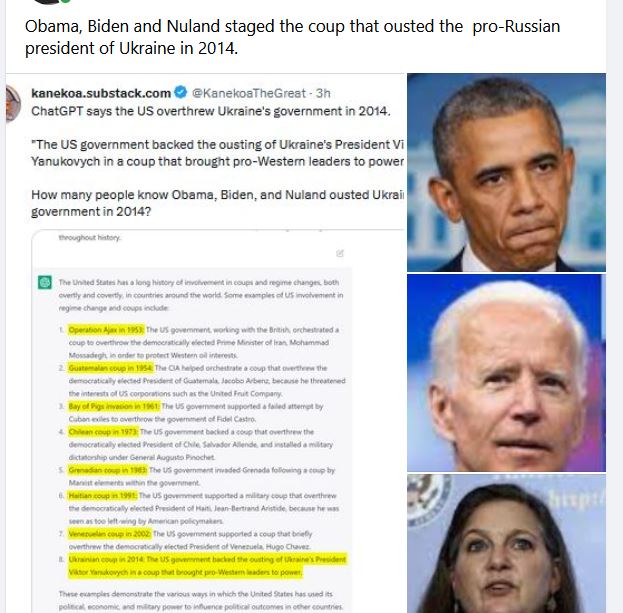
DID THE CIA AND OR BIDENS PARTICIPATE IN THIS OVERTHROW
AMERICAN PARTICIPATION IN OTHER REGIME CHANGES SUGGESTS A ROLE


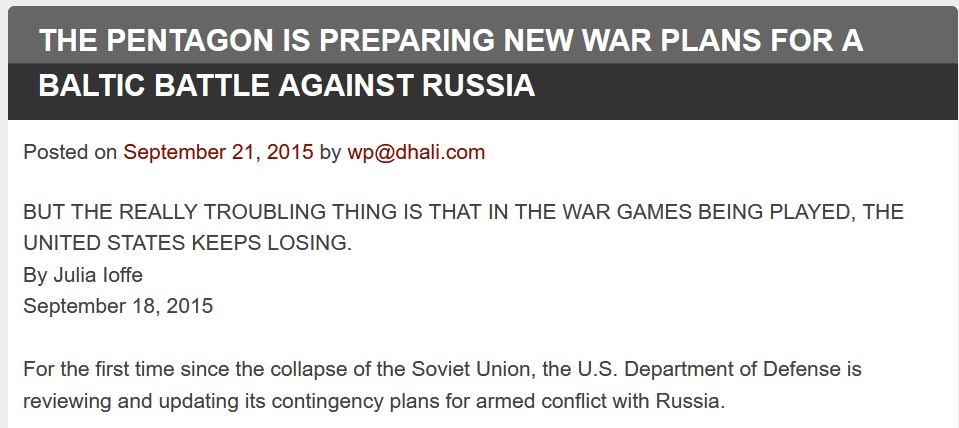
THEN PENTAGON POSTS THIS September 18, 2015, 1:26 PM

DELIBERATION OF THESE GEOPOLITICAL EVENTS WOULD LEAD ONE TO THE CONCLUSION THAT A WAR IS COMING LIKE IT OR NOT SO PERHAPS ITS WISE TO TAKE THE INITIATIVE AND SET THE SCENE SO ITS NOT A SURPRISE. Putin once asked to join NATO. He was turned down. It would appear NATO had other plans for him including sanctions and a freeze on SWIFT banking.
THE COUP 2014
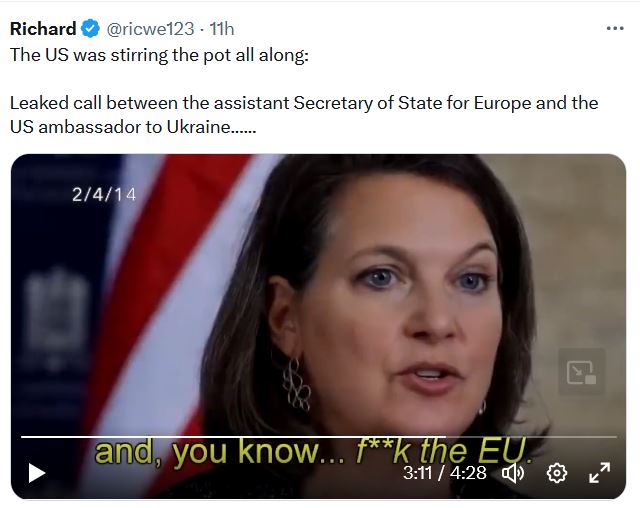
Nulands role in stirring the pot in Ukraine to Capture Russia
The Neocon project to topple Putin and Nulandize Russia has backfired terribly. The plan began with engineering the Kiev coup and installing an obedient govt the Neocons could control. They then armed Ukraine to the teeth and just let nazionalists do what comes to nazionalists naturally, which is persecute and slaughter disobedient minorities. Soon after grabbing power they began conducting provocations against the ethnic Russian population in eastern Ukraine. That population wanted nothing to do with the nazionalists running the country, so they broke away and declared independence. The Donetsk and Luhansk breakaway humiliated the nazionalists terribly, so Kiev mounted a military campaign to suppress them. That didn’t go well, and ultimately, over the better part of decade, with aid from Russia, the separatists prevailed. Crimea fared much better thanks to geography, holding a vote and reuniting with the Russian Federation in a whirlwind process. Then in late 2021, early 2022, the nazionalists were gearing up for an operation to overthrow the separatist governments, having amassed a force of 60,000 near Donbass for the job. The nazionalists didn’t want the actual population and would have been fine with just killing everyone and/or deporting them all, but rightfully it was ethnic Russian land and the residents were going to fight for it. Putin was stuck between a rock and a hard place. The Russian public had been demanding the Kremlin to do something about the plight of Donbass people for many years, and if Putin had not come to their defense his reputation would have suffered badly, and indeed was suffering. The pivotal event in this history was the Kiev coup, of which Nuland played the key role. The Neocon plot all along has been to destabilize Russia, topple Putin, engineer a “Moscow Maidan,” and repeat what they did to Ukraine. Russia is an incredibly resource wealthy country and the Neocons have been lusting after it ever since the collapse of the USSR. The Neocons knew that poking the bear would eventually draw a response and finally it worked. That was the signal to trigger the massive sanctions regime, which the Neocons were absolutely certain would result in the destabilization of Russia, the overthrow of Putin and a death blow to the economy. What they didn’t count on was Russia insulating itself from the effects of sanctions, a process that started in 2014 after the annexation of Crimea. While the sanctions did give Russia some trouble, the pain was quickly dealt with and Russia was able to rapidly shift markets. Probably nobody is surprised how well it went more than Putin himself. Now 430,000 Ukrainian corpses (and counting) are pushing up daisies and experiencing the eternal dirt nap, and no single person in history has done more damage to Ukraine than Neocon utensil Victoria Nuland. The Neocon’s lust to “get Putin” has resulted in the biggest crisis in Europe in a generation and the destruction of a country. If there ever was a person who should rot behind bars for the rest of her life, it’s Miss Piggy. BRIC also adds to the economic woes of America.
Pentagon Announces New War Plan for Baltic 2015
 Personal Page of Jorma Jyrkkanen, Composer, Author, Researcher